
The Jitters of California Parenting with a Teen Driver
You’ve watched them grow, taught them to ride a bike, then helped them study for that driver’s permit. Now, your teenager has their license. It’s a huge milestone. For them, it’s freedom. For you? It often feels like a knot in your stomach. Driving in California is already a challenge for seasoned adults, let alone a newly licensed 16-year-old. Our freeways, the traffic snarls in the Valley, the winding roads of Ventura County – they all create a unique pressure cooker for young drivers. You worry about fender benders, sure, but what really keeps you up at night are the “what ifs.” What if there’s a serious accident? What if someone gets badly hurt? What if your family ends up facing a lawsuit that wipes out everything you’ve worked for?
Those fears aren’t just parental paranoia. They’re rooted in a very real, very expensive reality. A teenager behind the wheel, no matter how responsible, introduces a significant layer of risk to your family’s financial well-being. And in a state like California, where everything seems to cost more, the stakes are exceptionally high.
Why Teen Drivers Change Everything for Your Insurance
Let’s be honest, adding a teenage driver to your car insurance policy isn’t a minor tweak. It’s often a seismic event for your premiums. Insurers know the statistics: new drivers, especially those under 20, have higher accident rates than any other age group. Their inexperience, coupled with common distractions like cell phones or friends in the car, makes them more prone to collisions.
Think about it. One moment, your kid is driving home from a Friday night football game in the Inland Empire. The next, a momentary lapse of attention could lead to a multi-car pileup on the 101. Suddenly, you’re not just dealing with car repairs. You’re looking at medical bills for multiple injured parties, lost wages, pain and suffering. Standard auto insurance policies, even those with decent liability limits, can hit their ceiling alarmingly fast in scenarios like these.
A typical California auto policy might offer $250,000 per person and $500,000 per accident for bodily injury liability. Sounds like a lot, doesn’t it? But here’s where it gets interesting. Imagine an accident involving three people with severe injuries – maybe a broken leg, a concussion, a spinal injury. Medical costs alone could easily exceed your policy limits. A jury in Los Angeles or San Francisco might award millions in damages in a serious injury case. That’s a big difference. When your auto policy limits are exhausted, who pays the rest? You do. Directly from your savings, your home equity, your future earnings.

An Extra Layer of Protection for Your California Life
This is precisely where umbrella insurance steps in. Think of it as a giant, protective canopy spread over your existing auto and homeowners policies. It’s not just for rainy days; it’s for catastrophic downpours. Umbrella insurance provides an additional layer of liability coverage, typically starting at $1 million and going up from there, that kicks in when the liability limits of your other policies are maxed out.
It’s surprisingly simple in concept. You have a car accident. Your underlying auto insurance pays out its maximum. If the damages awarded or settled are still higher, your umbrella policy then takes over to cover the difference, up to its own limit. This protects your personal assets from being seized or liquidated to pay off a judgment. It’s a financial safety net designed to absorb the kind of shocks that could otherwise devastate a family.
How Umbrella Insurance Really Helps with Teen Drivers
The direct benefit for families with teenage drivers is clear: increased financial protection against significant liability claims arising from car accidents. Your teen makes a mistake – and let’s be honest, they will – and someone is seriously injured. Without an umbrella policy, your family could be on the hook for hundreds of thousands, even millions, out-of-pocket.
Consider a scenario: your teen is driving to Santa Barbara for a weekend trip. Distracted, they swerve, causing a chain reaction crash that involves several vehicles and sends multiple people to the hospital. The medical bills pile up fast. Lost income for the injured parties. Pain and suffering. A lawsuit follows. Your auto policy quickly pays its $500,000 limit. But the total damages awarded by the court are $2.5 million. Where does that extra $2 million come from? Without an umbrella policy, it comes from your family. Your home, your investments, your retirement savings – all become targets. But with a $2 million umbrella policy, that $2 million gap is covered, leaving your family’s assets intact.
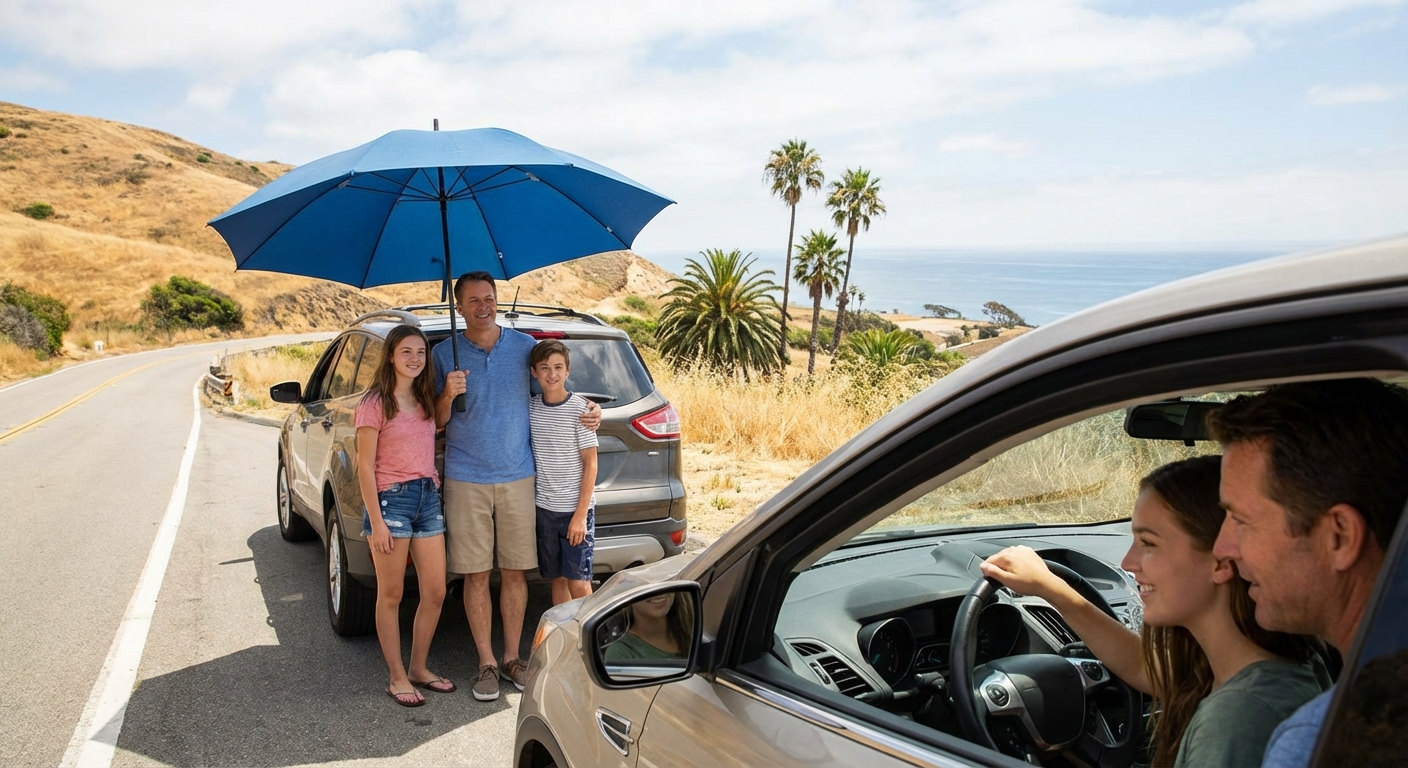
Beyond the Road: Other Teenage Risks an Umbrella Covers
But wait – it’s not just about cars. Teenagers, bless their hearts, come with a whole host of other potential liability exposures. An umbrella policy doesn’t just cover car accidents; it extends to other personal liability situations.
For instance, what if your teen hosts a party at your house while you’re out, and someone gets hurt? Maybe a guest trips on a loose rug, falls down the stairs, and suffers a serious injury. Or what about social media? Teenagers often don’t think before they post. A seemingly innocent but ill-advised comment or photo could lead to a defamation lawsuit. Or your family dog, usually gentle, nips a delivery person, causing an infection. These are all scenarios where your homeowners insurance might offer some protection, but again, its limits can be quickly exhausted. An umbrella policy steps in to provide that extra layer of defense, protecting you from lawsuits stemming from these, and many other, everyday events involving your kids.
The California Angle: Why This State Demands Extra Caution
California is, in many ways, an amazing place to live. It’s also an incredibly expensive and litigious one. The cost of living here is astronomical. Medical care, property values, jury awards – they all reflect this high-cost environment. What might be a $100,000 lawsuit in another state could easily be a $1 million judgment in California. This means that liability limits that seem adequate elsewhere can be woefully insufficient here.
We’ve also seen some shifts in the California insurance market recently. Premiums across the board have jumped, sometimes 30-40% between 2022 and 2024, partly due to inflation, climate events like the 2025 LA fires (projected), and a general tightening of the market. Some major insurers like State Farm, AAA, and Farmers have even pulled back from certain areas or limited new policies. This isn’t just about higher rates; it’s about a more cautious approach from insurers, which means they’re looking for ways to limit their exposure. For you, it means being more proactive about your own protection.
Prop 103, while designed to protect consumers, also adds layers of complexity to how rates are set and approved. The net effect? A somewhat unpredictable insurance climate. That unpredictability makes having robust protection even more important, especially when you have a higher-risk driver in the family.
The Cost of Peace of Mind (and How It’s Determined)
You might be thinking, “This sounds expensive.” Honestly, that’s a common initial thought. But here’s the thing. Umbrella insurance is often far more affordable than people expect, especially when compared to the potential cost of a major lawsuit.
Your premium isn’t a random number. It’s largely driven by a few key factors: the amount of coverage you choose (a $1 million policy will cost less than a $5 million policy), your driving records (especially your teen’s), and the underlying liability limits on your auto and homeowners policies. Insurers want to see that you have a good base layer of protection already in place. They typically require you to carry minimum liability limits on your auto and homeowners policies – perhaps $250,000/$500,000 on your auto and $300,000 on your home – before they’ll even issue an umbrella policy. This ensures that the umbrella truly acts as an *excess* layer, not a primary one.
While I can’t give you specific rates, I can tell you that for many families, a $1 million umbrella policy can cost just a few hundred dollars a year. That’s a small price to pay for potentially millions in liability protection and, frankly, a much better night’s sleep.
Getting Covered: Finding the Right Fit for Your Family
So, you’re convinced you need this extra protection. What’s the next step? The best approach is to talk to an independent insurance agent who understands the California market. They can help you assess your specific needs, review your current policies, and find an umbrella policy that fits your family’s risk profile and budget.
Why an Independent Agent Like Karl Susman Makes a Difference
You could try to figure this all out yourself, but why would you? Insurance can be confusing, and when you’re dealing with the complexities of California law and the added risk of a teenage driver, you want someone in your corner. An independent agent isn’t tied to one specific insurance company. They work for *you*. This means they can shop around with multiple carriers – State Farm, AAA, Farmers, and many others – to find the best coverage and price for your family.
Someone like Karl Susman, with California Umbrella Insurance (CA License #0B75129), has years of experience helping California families just like yours. He understands the unique challenges of our state and the specific concerns that come with teenage drivers. He can help you understand the requirements, explain the nuances, and get you a personalized quote. You can reach out to Karl and his team by calling (877) 411-5200. Getting a quote is easy, and it gives you clarity.
Want to take the first step toward protecting your family? Visit https://californiaumbrellainsurance.com/quote/ to start the conversation about a California umbrella insurance policy.
Frequently Asked Questions About Umbrella Insurance and Teen Drivers
Does my teen driver need to be listed on my umbrella policy?
No, not directly. Your umbrella policy doesn’t list individual drivers like your auto policy does. Instead, it covers all members of your household, including your teenage children, as long as they are covered by your underlying auto and homeowners insurance policies. The umbrella policy simply extends the liability coverage for those underlying policies.
Will my umbrella premium go up a lot when I add a teen driver?
Your umbrella premium might increase slightly when you add a teenage driver, but typically not as dramatically as your auto insurance premium. The primary impact of a teen driver is on your auto policy, which then serves as the foundation for your umbrella coverage. Insurers offering umbrella policies will look at the overall risk, including the presence of young drivers, but the increase is usually modest compared to the added peace of mind.
Can I get umbrella insurance if my teen has a bad driving record?
This can be trickier. If your teen has multiple tickets or accidents, it might make it harder to qualify for an umbrella policy, or the underlying auto policy might become very expensive or even non-renewable. However, it’s not impossible. An independent agent can assess your specific situation and try to find carriers willing to offer coverage. It often depends on the severity and frequency of the incidents.
What’s the minimum amount of umbrella coverage I should get?
Most experts recommend at least $1 million in umbrella coverage. However, the “right” amount depends entirely on your personal assets – your home equity, savings, investments, and future earning potential. The goal is to have enough coverage to protect everything you own from a catastrophic lawsuit. An independent agent can help you determine a suitable amount based on your financial picture.
Ready to explore your options and get a tailored quote for your family’s protection? Head over to https://californiaumbrellainsurance.com/quote/ and take the first step.
This article is for informational purposes only and does not constitute financial advice.